If coffee matters to you, the temperature should too.
Get a FREE first bag of coffee from our friends at Atlas Coffee Club when you subscribe. Enter your email to get the deal.
Water temperature is one of several things that affect extraction, alongside grind size, brew time and coffee-to-water ratio. Changing it can help you adjust the flavor of your cup.
There is no single perfect temperature for every bean and brewing method. Start with your brewer or recipe’s guidance, then adjust one variable at a time.
A Useful Starting Point for Hot Coffee
For many hot filter-coffee methods, roughly 92–96°C (198–205°F) is a useful starting range. It is not a rule for every coffee. Research discussed by the Specialty Coffee Association shows why temperature should be considered alongside extraction and brew strength, rather than treated as one universal flavor target.
A suitable thermometer or temperature-controlled kettle helps you repeat a setting you like. Your coffee, roast, grind and brewing method may call for a different temperature.
What Happens if You Brew at the Wrong Temperature?
Since water temperature can make or break your brew, it’s important to understand why brewing too hot or too cold can ruin your coffee.
Hotter water generally speeds extraction; cooler water slows it. Whether that produces a cup you enjoy also depends on grind size, contact time and brew ratio. If a cup tastes harsh or weak, change one variable at a time so you can judge the result.
There is no need to keep a kettle boiling once you have the hot water you need. A fixed cooling time after boiling is only an estimate, because the amount of water, kettle and room conditions affect how quickly it cools.
Gadgets to Get the Job Done
A food-safe probe thermometer suitable for hot water can help check your brewing temperature. An infrared thermometer measures a surface, so it is not a direct replacement for measuring the water with a suitable probe.
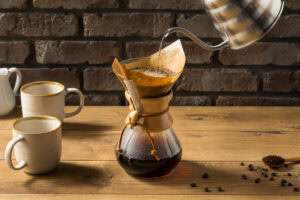
Another handy tool is the electric gooseneck kettle. This kettle has an electronic base that allows you to set and monitor the exact temperature of the water inside. Check the kettle’s operating instructions and temperature accuracy rather than assuming its display is exact.
Tip: If you’re working with a plain pot or kettle (never both, lest accusations of blackness fly unbidden through your kitchen), you can always use the time-tested method our forefathers used at Ye Olde Beane & Brew, or wherever colonial hipsters went: just boil it. Once it’s boiled, remove for 30 seconds, which will typically give you something in the 199-205 degree neighborhood.
And while we’re talking water, remember: depending on where you live, tap water may adversely affect your coffee. Always use filtered water to ensure the best possible brew.
What About Cold Coffee?
For hot coffee, brewing time can take anywhere between 2-4 minutes to achieve the ideal extraction. There are two methods of temperature for cold-brewing coffee: steeping at room temperature (around 70 degrees Fahrenheit) and steeping at “standard refrigerator” temperature (about 35 degrees F).
When steeping in room temperature, you can brew with either cold water or room-temperature water (just as long as it doesn’t get hot). Since the temperature is warmer, the steeping time doesn’t take as long, normally around 8-12 hours (we recommend about 10). Because the temperature is warmer the coffee tends to extract more, yielding a more heavy-bodied, robust flavor of the coffee.
The colder the temperature of the water is, the longer it takes to extract the flavors in the grounds. This method of cold brewing can take anywhere from 12-20 hours (we recommend around 16). Benefits of keeping the steeping process cold are that it takes longer to extract, making it lighter in taste. It also highlights the flavors and undertones more and produces coffee that’s less acidic.
Cooling Down…
It can be disappointing when your brew doesn’t taste as well as you’d hoped. But the great news is that almost every complication you encounter can be fixed, so have no fear!
Temperature is one of the most important qualities of coffee. Keeping an accurate, consistent temperature is even more important. However, if you’re still running into problems with flavor, take a breath, analyze the situation, and begin diagnosing the problem one small step at a time.
Happy caffeinating!